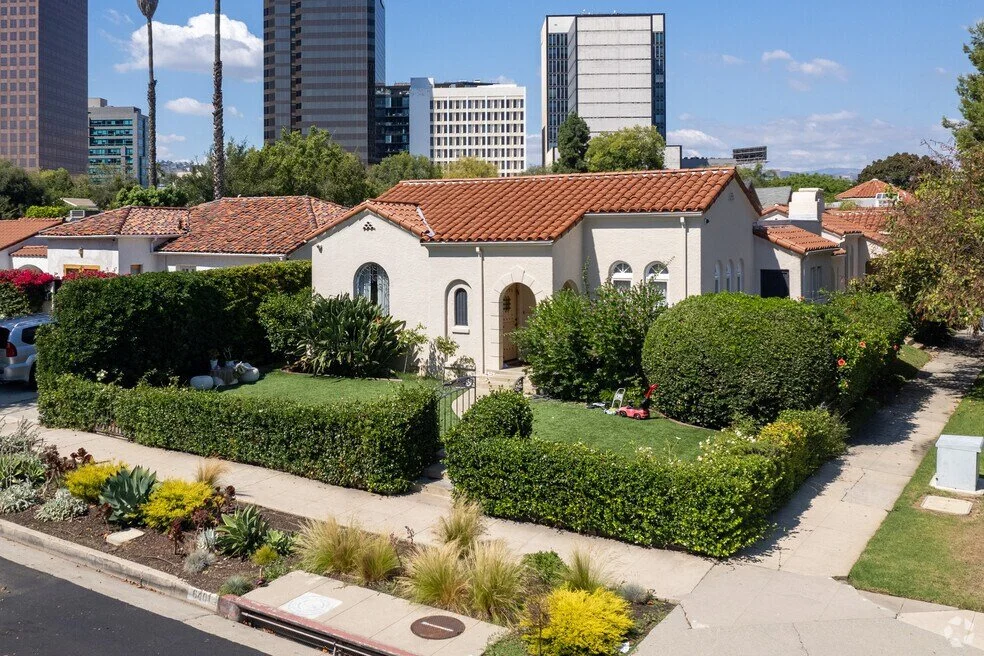
If you've spent any time looking at homes in Mid-City Los Angeles, you've probably driven through Carthay Square without realizing it. The streets are quiet. The homes are beautiful. The trees are old enough that they arch over the road. And almost every buyer I've worked with has the same reaction the first time I take them there: why doesn't anyone talk about this neighborhood?
The honest answer is that the people who live there prefer it that way. But if you're looking to buy in the Miracle Mile corridor — or if you're a seller trying to understand what makes your home different from everything else on the market — Carthay Square deserves your full attention.
What Is Carthay Square?
Carthay Square is a residential neighborhood in Mid-City Los Angeles, situated just south of Wilshire Boulevard between Fairfax Avenue and La Brea Avenue. It sits at the heart of what I call the Miracle Mile corridor — the stretch of neighborhoods that runs along Wilshire and into the residential streets below, including Miracle Mile proper, Carthay Square, Beverly Center, and Hancock Park-Wilshire.
The neighborhood was developed in the 1920s and 1930s, which is why the architecture looks the way it does. Spanish Colonial, Mediterranean Revival, Tudor, Storybook — these aren't styles that were added later. They're original. The bones of these homes are genuinely historic, and the neighborhood has been protected ever since.
The HPOZ: What It Means and Why It Matters
Carthay Square is designated as a Historic Preservation Overlay Zone (HPOZ) by the City of Los Angeles. That designation sounds bureaucratic, but what it actually means for buyers and sellers is significant.
An HPOZ protects the architectural character of a neighborhood. Any exterior changes to a home — additions, alterations, new construction — have to go through a review process to ensure they're consistent with the neighborhood's historic character. That might sound like a constraint, but in practice, it's one of the most powerful value-protection tools a neighborhood can have.
Here's what HPOZ status does for Carthay Square:
It prevents overdevelopment. You won't see a 1920s bungalow torn down to build a boxy new construction next door. The neighborhood looks today the way it was designed to look — and that consistency is exactly what buyers are paying for.
It supports long-term appreciation. HPOZ neighborhoods in Los Angeles have historically held their value better than comparable non-designated neighborhoods during market downturns. The architectural integrity that attracts buyers in the first place doesn't disappear when the market softens.
It gives sellers a differentiator. When I'm representing a Carthay Square seller, I'm not selling a house — I'm selling a protected piece of Los Angeles history. That's a different conversation than the one happening in the new construction market.
Who Buys in Carthay Square?
In my experience working in this corridor, Carthay Square attracts a specific kind of buyer. Usually they've already looked at Hancock Park and found the prices too high. Or they looked at Silver Lake and found the lots too small. Or they looked at Beverly Hills-adjacent and realized they were paying for a zip code they didn't actually care about.
Carthay Square is for buyers who want real architecture, real trees, and real neighborhood character — without paying Beverly Hills prices to get it.
The buyers I work with here tend to fall into a few categories:
First-time buyers moving up from condos who want their first house to actually feel like a house. The price point is more accessible than Hancock Park, and the homes are significantly more interesting than what you find in West LA new construction at the same number.
Buyers relocating from other cities — New York, Chicago, the Bay Area — who are used to historic housing stock and refuse to settle for a 1990s stucco box. These buyers come in knowing what they want, and Carthay Square delivers it.
Investors who understand value. The HPOZ designation, the location between Fairfax and La Brea, the walkability to Museum Row — these are fundamentals that hold. I've seen investors pass on flashier neighborhoods to put their money here, and I understand why.
The Location Advantage
Carthay Square's position in the city is one of its most underappreciated assets. From the residential streets, you're a short walk from:
Museum Row on Wilshire — LACMA, the La Brea Tar Pits, the Academy Museum
The Original Farmers Market and The Grove at Fairfax and 3rd
Meyers Manx on Wilshire — if you live here long enough, the breakfast burrito becomes non-negotiable
Republique on La Brea, one of the best restaurants in Los Angeles
Pan Pacific Park, one of the most underrated green spaces in the city
The 10 freeway is close enough to be useful. The neighborhood is walkable enough that many residents don't need it daily. That balance is harder to find in Los Angeles than people realize.
A Note on the Name
If you've been to Disneyland, you've walked through Carthay Circle — the idealized small-town centerpiece of the park. That design was directly inspired by the Carthay Circle Theatre, which stood on the east end of this neighborhood until 1969. Snow White and the Seven Dwarfs premiered there in 1937.
It's a small thing, but it's the kind of history that reminds you these streets meant something before they became real estate listings. When I tell buyers they're looking at a neighborhood that was important enough to be recreated inside the most visited theme park in the world, it lands differently than a comp sheet.
What Does It Cost?
Pricing in Carthay Square reflects the neighborhood's quality and its relatively low inventory. Single-family homes in the HPOZ core typically range from the high $1.5 millions into the $2 millions range depending on size, condition, and lot. Larger homes on better streets trade above that.
Inventory is consistently tight here. When a well-priced home comes to market in Carthay Square, it moves. Buyers who aren't already paying attention to this neighborhood often find out about it when they miss their first opportunity — and then they become the clients who call me and say find me the next one.
Thinking About Buying or Selling in Carthay Square?
I've worked in this corridor long enough to know when a home is priced right, when a seller has leverage they're not using, and when a buyer should move fast versus wait. The Miracle Mile corridor — Miracle Mile, Carthay Square, and the surrounding neighborhoods — is where I do my best work.
If you're curious about what your home is worth, or what's available, I'm happy to talk through it. No pitch, no pressure — just a straight conversation about what the market is doing and what it means for you.